

20+ Years of Weight Loss Surgery Experience.
Have questions about weight loss surgery? Our FAQ covers everything you need to know, including the benefits, recovery process, dietary changes, and insurance coverage. Whether you’re considering a gastric sleeve, gastric bypass, or revision surgery, find clear answers to help you make an informed decision about your journey to better health.
Dr. Choi has over 23 years of healthcare experience.
Dr. Michael Choi, D.O. is affiliated with Broward Health Imperial Point and Memorial Hospital Miramar in Florida.
Yes, Dr. Choi performs gallbladder surgery. Gallstones are often the cause of gallbladder problems. These are small, hard deposits that form in the gallbladder. They can also get into the bile duct, which connects the gallbladder with your intestines.
Dr. Choi’s most memorable weight loss surgery was about a fisherman whom he had operated on in Florida. The patient had gone to numerous places and had problems with his insurance coverage and finally came to Dr. Choi. He operated on the patient who weighed over 400 pounds at that time, and now he lost more than 100 pounds after the gastro sleeve. His hypertension and diabetes have also resolved, which Dr. Choi considers the most rewarding thing about doing weight loss surgery.
A Weight Loss Doctor / Surgeon is a doctor who specializes in helping patients lose weight through weight loss surgery. It is important to know the experience and credentials of your chosen surgeon to ensure quality and safety.
A Weight Loss Doctor / Surgeon is a doctor who specializes in helping patients lose weight through weight loss surgery. It is important to know the experience and credentials of your chosen surgeon to ensure quality and safety.
If you have comorbidities (like hypertension, diabetes, sleep apnea, high cholesterol) and are a candidate for weight loss surgery, there is a 70% to 80% chance that you will have weight loss after surgery and almost all of these comorbidities will also go away after surgery. All of these will help you fend off having a possible heart attack in the future.
Usually, it’s about 5 days minimum and 7 to 10 days maximum. However, it still depends on the individual.
People who have terminal cancer, anticoagulation problems, blood problems, and terminal illnesses won’t be great candidates for surgery. However if necessary, we will get consultations with the specific doctors to make sure you are a candidate for the surgery.
There is a 70% chance that your sleep apnea will resolve.
Whether you have any comorbidities or not, we highly recommend a stress test, blood work, and EKG just to make sure that there are no blockages or other problems prior to the surgery and to make sure that you are a great candidate to have weight loss surgery.
Dr. Choi recommends for patients to simply take a walk. It is also important to note not to drink water or push it down by drinking as it will not work. You just need to relax, walk, give it time, and not push it by any drink.
Out of the 5,000 cases that Dr. Choi has done, no one has ever complained about scarring. This is because the scarring is very minimal. The sutures are put underneath the skin, and they also dissolve underneath the skin hence no need to remove anything after your post-op clinic follow-up.
We will give you a pre and post-diet plan as your guide. For the first week, it will be just clear liquids. For the second week, it will be full liquids. For the third week, it will be a soft diet. After a month, your diet will comprise regular foods but in smaller quantities. You can always call/text our office, or reach us through our website for any questions. In addition to that, somebody from our office will reach out to you on a daily basis to make sure everything is fine. Dr. Choi will possibly call to check on you as well. After a week, you will need to come back for a post-op visit just to make sure everything is fine.
Right away! You will take gentle, short walks even while you are in the hospital. The key is to start slow. Listen to your body and your surgeon. If you lift weights or do sports, stay “low impact” for the first month (avoid competition, think participation). Build slowly over several weeks. If you swim, your wounds need to be healed before you get back in the water.
Yes and no.
Most people think of a “diet” as a plan that leaves you hungry. That is not the way people feel after surgery. Eventually, most patients get some form of appetite back 6-18 months after surgery. Your appetite is much weaker, and easier to satisfy than before.
This does not mean that you can eat whatever and whenever you want. Healthier food choices are important for best results, but most patients still enjoy tasty food and even “treats.”
Most patients also think of exercise as something that must be intense and painful (like “boot camp”). Regular, modest activity is far more useful in the long term. Even elite athletes can’t stay at a “peak” every week of the year. Sometimes exercise is work, but if it becomes a punishing, never-ending battle, you will not keep going. Instead, work with your surgeon’s program to find a variety of activities that can work for you. There is no “one-size-fits-all” plan. Expect to learn and change as you go!
For many patients (and normal-weight people, too) exercise is more important for regular stress control, and appetite control, than simply burning off calories. As we age, inactivity can lead to being frail or fragile, which is quite dangerous to overall health. Healthy bones and avoiding muscle loss partly depend on doing weekly weight bearing (including walking) or muscle resistance (weights or similar) exercises.
As you lose weight, you may be able to reduce or eliminate the need for many of the medications you take for high blood pressure, heart disease, arthritis, cholesterol, and diabetes. If you have a gastric bypass, sleeve gastrectomy, or a duodenal switch, you may even be able to reduce the dosage or discontinue the use of your diabetes medications soon after your procedure.
If you have a body mass index, which is calculated from your height and weight, greater than 40 or equal to 40 you automatically qualify for bariatric surgery. If you meet the standards of body mass index of 35, you would need two comorbidities like hypertension, diabetes, and possibly sleep apnea. They’re opening up another frontier or the possibility that, if you have a minimum of 30 BMI, you will also be a candidate for weight loss surgery, and that would be the minimum for the whole United States right now.
Lap band fill is when Dr. Choi places a needle under a port that is underneath your skin on your abdominal wall, then injects saline fluid which will fill the balloon pouches that are around your stomach. You then need to come in every 6 to 8 weeks to get more fluid which would mean that the entrance to your stomach will get smaller and smaller because of the fills.
The band is positioned over the GE junction and subsequently sealed. After that, you should come in periodically every 4 to 6 or 8 weeks to get a saline injection which will fill up the balloon and limit the amount of foods you can consume.
The band is positioned over the GE junction and subsequently sealed. After that, you should come in periodically every 4 to 6 or 8 weeks to get a saline injection which will fill up the balloon and limit the amount of foods you can consume.
These days it has become popular to just take the band out, put the stomach back into normal position then convert the stomach into a gastric sleeve.
VSG or Vertical Sleeve Gastrectomy is the same as a laparoscopic gastric sleeve. It is a procedure wherein your stomach size is reduced by 70% to 80%.
To put it simply, the gastric sleeve is cutting 70% to 80% of the stomach and make it look like a banana. With that said, after the surgery, you won’t get as hungry as you did in the past therefore you will no longer consume as much food as you had prior to the surgery.
It depends, Dr. Choi has patients that had no issues for more than 10 to 15 years, and some people have had issues after 3 to 4 years.
Some people need 7 to 10 days, as a maximum amount of time, and the minimum is about 5 days.
Normally, the most painful part is only during the incision stage. Some patients have described having pain equivalent to or less than having a C-section for women.
The most painful part of having gastric sleeve surgery is that some of the trochar sites will be in pain. However, you will be given a prescription for narcotics or pain pills that should take care of the pain. If you feel like you are not ready to go home, you have the option of staying in the hospital for one night.
There is no limitation on what you can and can’t do after a gastric sleeve. After the first week of surgery obviously, you are not expected to do strenuous activities like a marathon, but after that, you can be more active gradually. You can start going to a gym, be more active, and change your bad habits for a healthier lifestyle.
Yes, as long as you meet the minimum BMI of 29 or 30, you will be a great candidate for the surgery.
Within the first two weeks, it is better to stay away from having coffee. Eventually, you can start having decaffeinated coffee, then gradually transition to caffeinated coffee.
Yes, it is usually called liposuction. Though by having the sleeve gastrectomy, you will have natural liposuction, and you will see the visceral fat and other fats just melt away, due to your weight loss.
This has always been a frequent question, and the answer is no.
For Dr. Choi’s patients, they usually lose a minimum of 10 to 15 pounds per month after the operation. After 3 months, you’re looking at an average of 30 pounds to 45 pounds. It usually depends on the individual on how they change their lifestyle after gastric sleeve.
Yes, that is a possibility, your stomach can stretch out after gastric bypass if you overeat and you stretch the pouch out.
The gastric pouch can stretch just like a balloon if you overeat. The more you eat, the more it gets bigger which will make you feel more hungry.
There’s a new bariatric surgery procedure called Single Anastomosis Duodenal-Ileal Bypass (SADI). It serves as a secondary option for individuals who have previously undergone a gastric sleeve and now require a revision.
After a sleeve gastrectomy has failed, or the patient has put on weight, a single anastomosis duodenal-ileal bypass (SADI) will be involved. What will happen? Your surgeon will make an anastomosis from the intestines to the duodenum, then count back from the ileum area 300 centimeters or more, then make a new connection at the duodenum and finally, connect the ileum (the small bowel) to make that bypass. Dr. Choi is performing this surgery in Florida.
A gastric balloon is implemented endoscopically or you can swallow it. It is filled with gas or silicone and it’s placed in the stomach. It occupies space in your stomach and makes you full all the time. However, the only downside of having a gastric balloon is that the maximum amount of time that a balloon can last inside your stomach and stay there is only 6 to 9 months. So it kind of defeats the purpose because once you take that balloon out, you start gaining weight again.
Yes, bariatric surgery is considered general surgery.
A few things to keep in mind would be, if the surgeon has MIS (Minimally Invasive Surgeon) fellowship training, meaning MIS surgeon or surgery trained. Also look for someone who is board certified, one that does more than 2 surgeries a week, 10 to 20 surgeries a month or does a minimum of 50 to 100 surgerie
There is no limitation on age. However, Dr. Choi would like to have a cut-off between 70 and 80 years old.
The four types of bariatric surgery are:
After surgery, the best thing that you can do is go for walks, in the room, at home, or outside because the more you walk, the more you get the CO2 gas out of your belly. This expedites the healing process and will make you feel better.
The average weight you lose after bariatric surgery is about 70% to 80% of excess weight loss, depending on what surgery you have.
Most people lose a lot of unhealthy weight after bariatric surgery. It is very rare that patients gain the weight back after the surgery, though if patients overeat again this may stretch the pouch or the sleeve out which may lead to weight gain.
No, it is not harder to lose weight after bariatric surgery. That is the main point of the surgery, for the patient to lose 70 or 80 pounds, which will also lead to losing their comorbidities.
There is no weight limit, but there is a minimum weight requirement. Based on the American Society of Bariatric Surgeons the minimum amount is a 29 BMI.
Dr. Choi usually does a plastic closure for all his patients, meaning that all the stitches will dissolve underneath the skin so that there will be no need to cut anything or remove anything afterward.
Yes, best 2 to 3 weeks after the surgery. Dr. Choi would love for the patients to get into the gym and start walking. Exercise will help you get a faster recovery.
Yes, but not within the first 2 to 3 weeks. Depending on the individual, you can resume all the exercises and activities that you were doing before the surgery.
There is no weight cut-off for bariatric surgery. Although there is a minimum BMI of 29 to 30 by the guidelines of the American Society of Bariatric Surgeons.
The standard guidelines as per the American Society of Bariatric Surgeons are that you must have at least a minimum of 29 BMI (Body Mass Index) to be a candidate for weight loss surgery.
No, scarring will be very minimal. A good laparoscopic surgeon won’t need to open you or have a big scar midline.
BMI (Body Mass Index) calculates your body fat to your height and weight. According to the American Society of Bariatric Surgeons, the minimum amount of BMI for you to have weight loss surgery is 29 to 30.
Signs that you have overeaten would include nausea, hiccups, burping, and pain in the stomach. How to prevent them? Eat with a smaller plate to make you more aware of how much you have eaten. Chew conservatively, take time while you are eating. Lastly, it is better to have small frequent meals.
After surgery, most patients return to work in one or two weeks. You will have low energy for a while after surgery and may need to have some half days or work every other day for your first week back. Your surgeon will give you clear instructions. Most jobs want you back in the workplace as soon as possible, even if you can’t perform ALL duties right away. Your safety and the safety of others are extremely important – low energy can be dangerous in some jobs.
Many patients are worried about getting hernias at incisions. That is almost never a problem from work or lifting. Hernias are more often the result of infection. You will not feel well if you do too much.
It can. Be sure to follow any instructions from your surgeon about managing your diabetes around the time of surgery. Almost everyone with Type 2 Diabetes sees big improvement or even complete remission after surgery. Some studies have even reported improvement in Type 1 Diabetes after bariatric procedures.
Most women are much more fertile after surgery, even with moderate pre-op weight loss. Birth control pills do NOT work as well in patients who are overweight. Birth control pills are not very reliable during the time your weight is changing. For this reason, having an IUD or using condoms and spermicide with ALL intercourse is needed. Menstrual periods can be very irregular, and you can get pregnant when you least expect it!
Most groups recommend waiting 12-18 months after surgery before getting pregnant.
Many women who become pregnant after surgery are several years older than their friends were when having kids. Being older when pregnant does mean possible increased risks of certain problems. Down syndrome and spinal deformities are two examples. The good news is that, after surgery, there is much less risk of experiencing problems during pregnancy (gestational diabetes, eclampsia, macrosomia) and during childbirth. There are also fewer miscarriages and stillbirths than in women with obesity who have not had surgery and weight loss.
Kids born after mom’s surgery are LESS at risk of being affected by obesity later, due to activation of certain genes during fetal growth (look up “epigenetics” – for more information). There is also less risk of needing a C-section.
Some hair loss is common between 3 and 6 months following surgery. The reasons for this are not totally understood. Even if you take all recommended supplements, hair loss will be noticed until the follicles come back. Hair loss is almost always temporary. Adequate intake of protein, vitamins, and minerals will help to ensure hair growth and avoid longer-term thinning.
Yes. Most bariatric surgeons put their patients on a special pre-operative diet, usually 2 or 3 weeks before surgery. The reason for the pre-operative diet is to shrink the liver and reduce fat in the abdomen. This helps during the procedure and makes it safer.
Some insurance companies require a physician-monitored diet three to six months prior to surgery as part of their coverage requirement. These diets are very different from the short-term diets and usually are more about food education and showing a willingness to complete appointments and to learn.
It’s a great idea to see a dietitian before and after your procedure because he or she will help you keep your calorie count intact. We would like to see them at least 6 to 8 weeks after the surgery, and then as you start reaching your goals, you can see them less and less, because by the time you lose more weight and learn how to eat, you become less reliant on your nutritionist or dietitian.
BMI (Body Mass Index) calculates your body fat to your height and weight. According to the American Society of Bariatric Surgeons, the minimum amount of BMI for you to have weight loss surgery is 29 to 30.
For Dr. Choi, a BMI of 40 or above is required, or 35+ if you have obesity-related health conditions like diabetes.
Any person with any BMI at any age can have gallbladder problems, it can affect anyone, everyone.
Lap-band surgery, even for individuals with a BMI of 30 to 40 can be helpful. Studies show that patients with lower BMI can achieve a reduction in excess body weight within two years post-surgery.
Ozempic, Wegovy and Semaglutide have recently gained attention in Florida for their effectiveness in aiding weight loss. Semaglutide works by slowing the emptying of your stomach, which helps you feel full longer and reduces the urge to eat frequently.
While gastric sleeve surgery significantly reduces the stomach’s size, it is designed to help you reach a healthy weight, not an unhealthily low BMI.
Studies show that reducing your BMI, even by a small amount, can help improve or even resolve type 2 diabetes. Weight loss through lifestyle changes, medication, or bariatric surgery has been proven to lower blood sugar levels and reduce the need for diabetes medications.
Gastroesophageal reflux disease (GERD) is more common in individuals with higher BMIs, as excess weight puts pressure on the stomach, causing stomach acid to flow back into the esophagus. Over two-thirds of U.S. adults are classified as overweight or obese, increasing the prevalence of GERD among this population.
Yes, having an elevated BMI has been linked to an increased risk of developing several types of cancer. Research shows that being overweight or obese can raise the risk for cancers such as breast cancer (in post-menopausal women), colorectal cancer, endometrial cancer, esophageal cancer, pancreatic cancer, and kidney cancer.
A BMI (Body Mass Index) calculator helps you quickly assess whether your weight is in a healthy range based on your height and weight. If your BMI is below 18.5, you’re considered underweight, while a BMI over 24.9 is classified as overweight. A BMI over 30 indicates obesity. Curious about your BMI? If you are in Florida, you can book a consultation with Dr. Choi for more accurate professional guidance.
They are not the same. The only similar thing about laparoscopic and robotic surgery is that you may notice is that we use trocars to enter the abdomen. We also dock the system called DaVinci or the robot to the patients which allows us to get better visualization and better results for the patients and their weight loss.
Laparoscopic surgery is very similar to robotic surgery, however, when you speak about robotics, we are using a machine called the DaVinci, where we dock the machine to the laparoscopic trocar sides. The difference between laparoscopic and robotic surgery would rely heavily on the vision. Robotics gives us better vision and 3D vision, and we can cut and be more precise with the robot than we would with the laparoscopic procedure.
If you ask Dr. Choi which one is better, laparoscopic or robotic surgery, he believes that robotic surgery is better in the sense that it allows him to see better, in a 3D fashion which allows him to get closer when he is making incisions and performing the sleeve gastrectomy which yields better results for the patients.
The answer is yes and no. The surgeon would first have to put a small little camera in to make sure there were no adhesions. As long as there were not extensive adhesions, and there was no possible injury to the bowel that could occur, if you have mesh your surgeon will be able to do the surgery laparoscopically. However, if there are extensive adhesions and the surgeon feels that it’s not safe, he or she won’t do the surgery.
Surgeons like Dr. Choi prefer robotic surgery because it is considered the best tool to help any surgeon. It gets them easier access to the abdomen, the robot also allows more sustainability to the stomach area which gets them better visualization and better results.
Yes, because it alleviates stress as the surgeon does not need to exert much physical force to perform the surgery, which also makes it a less tense surgery.
If you ask Dr. Choi about the disadvantages of robotic surgery he would tell you that there is no disadvantage and only sees it as an advantage. By doing it robotically, you gain so much visualization to perform a better procedure or create a better sleeve for the patient.
No, when we make the incisions, we use instruments called trocars that go in between the muscles and the fascia, which will cause less pain and less harm.
The procedure for removing the gallbladder is called a Gallbladder surgery. This is a very common procedure. When patients come in complaining of mid-epigastric pain or right upper quadrant pain and don’t know why is this happening, we usually do a workup for them, and do some tests like ultrasound, HIDA scan, or nuclear HIDA scan which will provide us with more information if the gallbladder is indeed the cause of the patient’s pain.
Yes, if you don’t have gallbladder surgery, you will not get better. You will have to have gallbladder surgery, called laparoscopic cystectomy, to remove the gallbladder. It is almost 90% that you will feel a lot better, and those pains in the right upper quadrant will go away.
So sometimes, due to your predisposition or genetics, you will form gallstones. Also having high cholesterol makes you prone to having gall stones, and once those gallstones are there they can irritate or cause inflammation at the gallbladder. You can also have a cystic duct obstruction which means that the bile is being blocked by a gall stone. Or you can have a stone in the common bile duct with affects the whole entire biliary tree. So there are specific tests that we like to do to make sure, but those would be some of the indications that you would need to have gallbladder surgery because otherwise, you will not get any better.
There really isn’t a way or an indicator to say, “Oh you’re going to have complications or your gallbladder taken out.” It’s mostly genetics, also diets, and also weight loss, so there’s a combination of things that will make you more inclined to have gallbladder surgery.
The answer is yes, you can have gallbladder removal and weight loss surgery at once. However, some people don’t like to do that at the same time, or the doctors don’t want to do both surgery at once. But it has been done in the past, but it is not a restriction that you have one surgery or the other. They can be done simultaneously if you like.
In this day and age robotic surgery is much more accessible than it was before, it is now accessible to all of the new residents who are coming out of training at this point. For Dr. Choi, he had to train himself, post-training.
Yes, most universities do teach courses that include practical experience in laparoscopic surgery.
The aim of this surgery is for the patient to be able to recover faster and have better results after the procedure. Minimally invasive surgery is making smaller incisions to access the abdomen of the patient which means we don’t need to open or make a midline incision like in the old way of general surgery.
A surgery performed to repair a hiatal hernia is called a hiatal hernia repair. There are two ways to correct this, posterior correction or an anterior correction. Both are acceptable in this day and age, but posterior correction is a little bit more guaranteeing reflux prevention in the future.
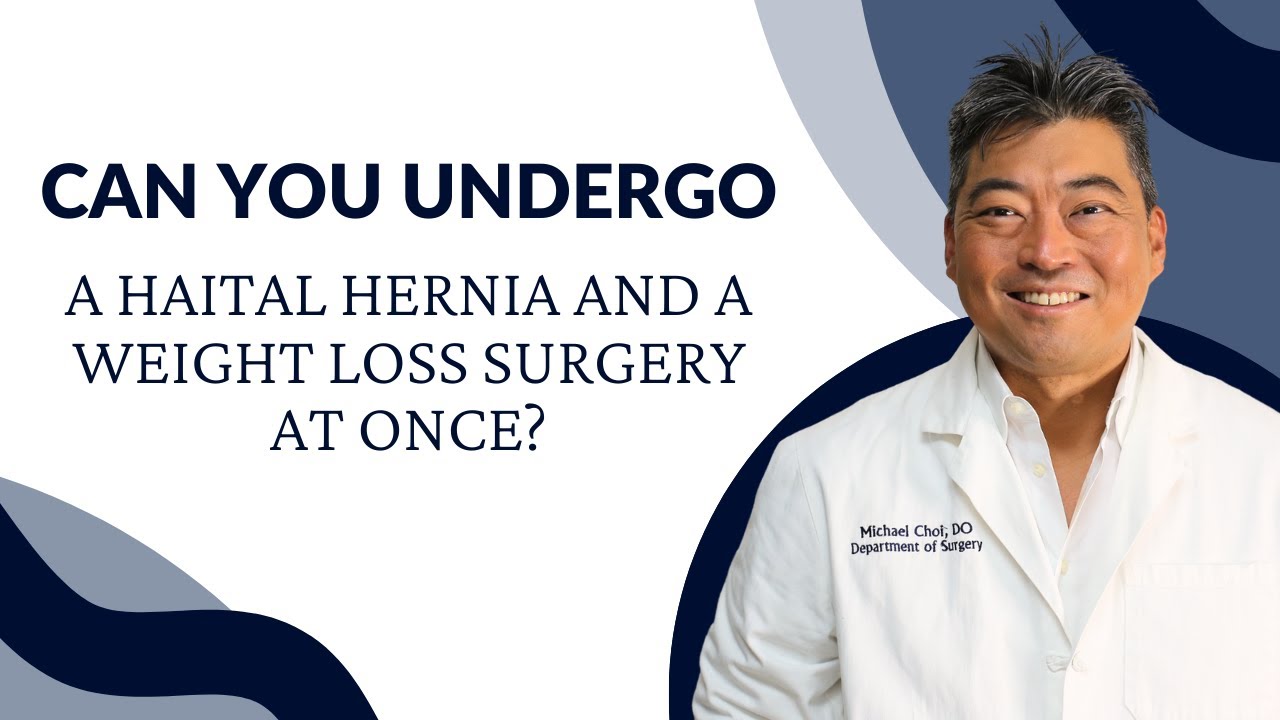
The answer is yes, you can have hiatal hernia and weight loss surgery at once. So what happens is sometimes the surgeon might incidentally find that you may have a hiatal hernia, and what they would do is to fix the hernia, then proceed either with the gastric bypass or a gastric sleeve. But yes, the answer is that it doesn’t prevent you from having the surgery.
The answer is yes, you can do crunches after hiatal hernia repair, but wait at least six to eight weeks so that the fixation and all the suturing is steady, and then slowly implement crunches and abdominal exercises so that you could get your abdominals back to where they were before.
It’s not that hard to avoid hiatal hernia, because you’re born with it. Congenitally, there’s a weakness at the site where the esophagus enters into the stomach and so therefore, you can’t prevent it. This is something that you are born with.
Hiatal hernia is a possible cause for acid reflux or heartburn, we also need to do some more testing. We have to get a 24-hour pH probe and manometry to locate and check if you have problems in your stomach. As soon as we pinpoint the cause of the problem, we will recommend appropriate treatments, surgical treatments such as Toupets or Nissen Fundoplications.
Yes, there is a surgery to address severe acid reflux. We just have to determine if you are a candidate for some type of anti-reflux surgery. Toupets and Nissen Fundoplications are some types of anti-reflux surgery that serve as an option for people who are not complaining of heartburn and who are not obese. We would get proper testing, EGDs, pH monitoring, 24-hour acid monitoring, and probes to be safe.
Once it is confirmed that your pain is really coming from the gallbladder, no ulcer or anything else in the stomach we will recommend a gallbladder surgery, which is called a laparoscopic cholecystectomy. The procedure, of removing your gallbladder will last about an hour or less. Usually, it will only involve 4 little incisions, then you may stay in the hospital for at least 23 hours, or you may be discharged the next day.
Any person with any BMI at any age can have gallbladder problems, it can affect anyone, everyone.
The general answer to this is yes. Make sure to tell your surgeon and anesthesiologist about all prior operations, especially those on your abdomen and pelvis. Many of us forget childhood operations. It is best to avoid surprises!
Sometimes your surgeon may ask to see the operative report from complicated or unusual procedures, especially those on the esophagus, stomach, or bowels.
Yes, but you may need medical clearance from your cardiologist. Bariatric surgery leads to improvement in most problems related to heart disease including:
During the screening process, be sure to let your surgeon or nurse know about any heart conditions you have. Even those with atrial fibrillation, heart valve replacement, previous stents or heart bypass surgery usually do very well. If you are on blood thinners of any type, expect special instructions just before and after surgery.
The best way to naturally reduce the size of a stomach is to eat healthy and exercise regularly. A healthy caloric intake is between 1200 to 1500 calories per day. Overeating will only lead to stretching your stomach out. Having a balanced diet is key to maintaining a healthy lifestyle.
Yes, there is a drug for weight loss and one of the popular ones is Semaglutide which was not really intended for weight loss but for treating type 2 diabetes. Ozempic, Wegovy, and Mounjaro are also some of the popular ones, and these drugs only work when you are taking them, once you stop taking them, you will just gain all your weight back.
There are a lot of popular drugs for weight loss recently like Wegovy, Ozempic, Semaglutide, and many others. It is important to know how it works and the possible side effects as well
90% of weight loss is your diet. You can come to us and help you get a dietician to help you control your caloric intake, and you also have to start exercising. If you are looking for an alternative for weight loss surgery, you can start just by walking for 30 – 45 minutes and gradually increase that up to an hour. The key to weight loss will always be diet. The more you control the amount of food you consume, the more success you will get in terms of losing weight.
If you are considering if it is better to lose weight or get surgery, surgery is proven to be more reliable than losing weight in curing obesity because in trying to lose weight there is a high possibility that you will gain weight again, then lose, then gain again, which is most commonly known as yo-yo dieting.
Currently, Vertical Sleeve Gastrectomy or Sleeve is the safest surgery for weight loss in the United States.
Yes, Dr. Choi accepts patients from all over the world. He takes patients from the US and the rest of the world, for example, EU countries, Switzerland, England, Israel, Canada, the Dominican Republic, Puerto Rico, and Guam, as well as patients from Asia and South America.
Yes, we offer options for financing, please follow this link for more details.
Some insurance requires this type of letter from either your surgeon or primary care provider before final approval for surgery. Many will just accept your surgeon’s consultation summary note. It is best to ask your insurer directly. Most companies want information pertaining to current weight, height, body mass index, the medical problems related to obesity, your past diet attempt history, and why the physician feels it is medically necessary for you to have bariatric surgery. Your bariatric surgeon will often have a sample letter of necessity for you to take to your primary care physician.
Most patients have some loose or sagging skin, but it is often more temporary than expected. You will have a lot of change between 6 and 18 months after surgery. Your individual appearance depends upon several things, including how much weight you lose, your age, your genetics, and whether or not you exercise or smoke. Generally, loose skin is well-hidden by clothing. Many patients wear compression garments, which can be found online, to help with appearance.
Some patients will choose to have plastic surgery to remove excess skin. Most surgeons recommend waiting at least 18 months, but you can be evaluated before that. Plastic surgery for the removal of excess abdominal and breast skin is often covered by insurance for reasons of moisture, hygiene, and rash issues.
Arms and other areas may not be covered if they are considered “purely” cosmetic by your insurer. Some of these “less invasive” operations can be done in the clinic, however – so they can be much more affordable!
Dr. Choi’s Florida clinic accepts various types of insurances, such as: Aetna, AvMed, Blue Cross, Cigna, Humana, and United Health Care. If your insurance is not mentioned, we can still check your services, as each year, each plan changes.
There are loan programs available to cover the cost of health expenses such as metabolic and bariatric surgery. Appeals to insurance companies or directly to your employer may reverse a denial of coverage. Metabolic and Bariatric surgery is a health expense that you can deduct from your income tax.
If you are not able to qualify for a loan, the Obesity Action Coalition (OAC) produces a helpful guide titled “Working with Your Insurance Provider – A Guide to Seeking Weight-loss Surgery.” This guide can help you work with your provider and advocate for your surgery to be covered. You can view the OAC guide on their website.
You will need to take a multivitamin for life. You may need higher doses of certain vitamins or minerals, especially Iron, Calcium, and Vitamin D. You will also need to have at least yearly lab checks. Insurance almost never pays for vitamin and mineral supplements but usually does pay for labs. A consultation with a dietitian is highly recommended.
Yes, absolutely. A cosigner for financing is possible.
Complications are often reported under a separate medical billing code. The insurance company may not cover these costs. Appeal is often very helpful, and direct contact with your hospital can make a big difference for final costs. Many surgeons also offer a special insurance policy to cover unexpected additional costs.
Over 160+ 5 Star Reviews and counting!


Get expert answers to all your weight loss surgery questions directly from Dr. Michael Choi, ensuring clarity and confidence in your journey.




South Florida’s #1 Bariatric Weight Loss Surgeon With Over 5,000+ Surgeries!


